
Understanding O Level L1R5 Scoring System & Calculation (2026)

The O level scoring system is not the easiest one to understand. You’ll hear students throwing around terms things like L1R5, contrasting subjects, and different requirements for JC and poly. How does it all work?
For parents or O level students still in the fog, here’s our quick explainer of the O level L1R5 scoring system for JC – and we’ve included the cut-off points for our local junior colleges at the end of the article as well.
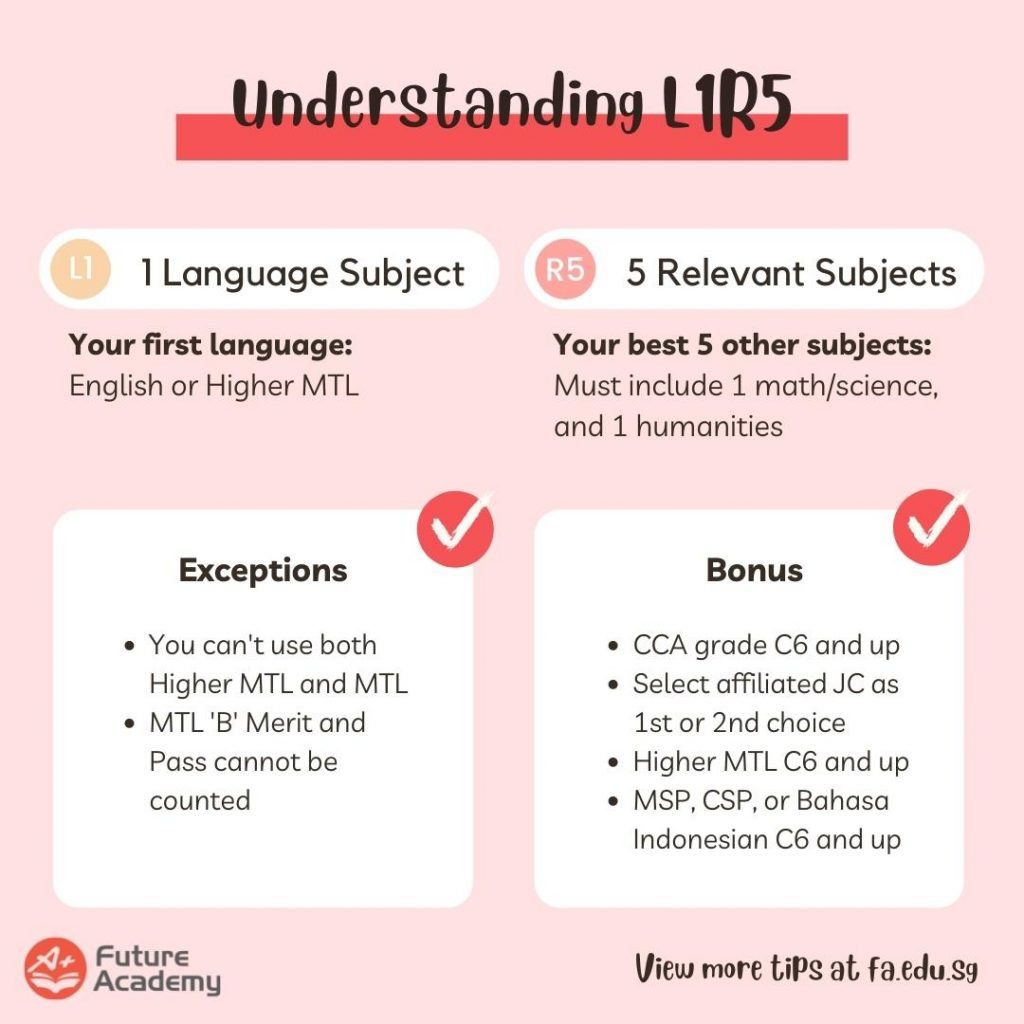
What is L1R5?
- L1: 1 Language Subject
- R5: 5 Relevant Subjects
L1R5 sounds like code for the new model of smartphone – or a friend of Star Wars’ R2D2! But let’s take it part by part, and you’ll see it is not too hard to understand.
First, L stands for Language, and 1 means 1 subject. This takes into account the grade for the student’s first language – in most cases, English. Students who have a good score for Higher Chinese may also use it as their L1.
R stands for relevant, and 5 means 5 subjects. Thus, R5 refers to the best scoring 5 relevant subjects, apart from what you already used for L1.
What counts in the R5?
- At least 1 math or science subject
- At least 1 humanities subject
Higher Music, Higher Art, Malay Special Programme, Chinese Special Programme, or Bahasa Indonesia can also be qualified as a humanities subject.
Exceptions: You can’t have both your Higher MTL and MTL subjects counted in. So, if you scored A for both Higher MTL and MTL, you can only use one of the As.
Students taking Mother Tongue ‘B’ languages also can’t use their grade if it is ‘merit’ or ‘pass’.
What is the L1R5 aggregate score?
If you are aiming to go to JC, you have to know that your L1R5 must not exceed 20. But where did the 20 even come from?
Recall that for each subject, you get a grade, ranging from A1 to F9. To calculate the aggregate score, you simply add up all the numbers, ignoring the letter grade.
For example:
Grades scored:
English: A2
MTL: B3
E Math: A1
Physics: A2
Geography: A2
Literature: B3
Aggregate score: 2+3+1+2+2+3 = 13 points

Bonus points for L1R5
Notice that a lower score is a better score. If you fulfil certain other conditions, you can also further deduct a few bonus points to reach an even better score.
- CCA grade of A1 or A2 (deduct 2 points)
- CCA grade of B3 to C6 (deduct 1 point)
- Higher MTL grade of C6 and above (deduct 2 points)
- Select an affiliated JC as 1st or 2nd choice school (deduct 2 points)
- Chinese or Malay Special Programme, or Bahasa Indonesia grade of C6 and above (deduct 2 points)
You can deduct a maximum of 4 points from these bonus conditions.
Requirements for JC
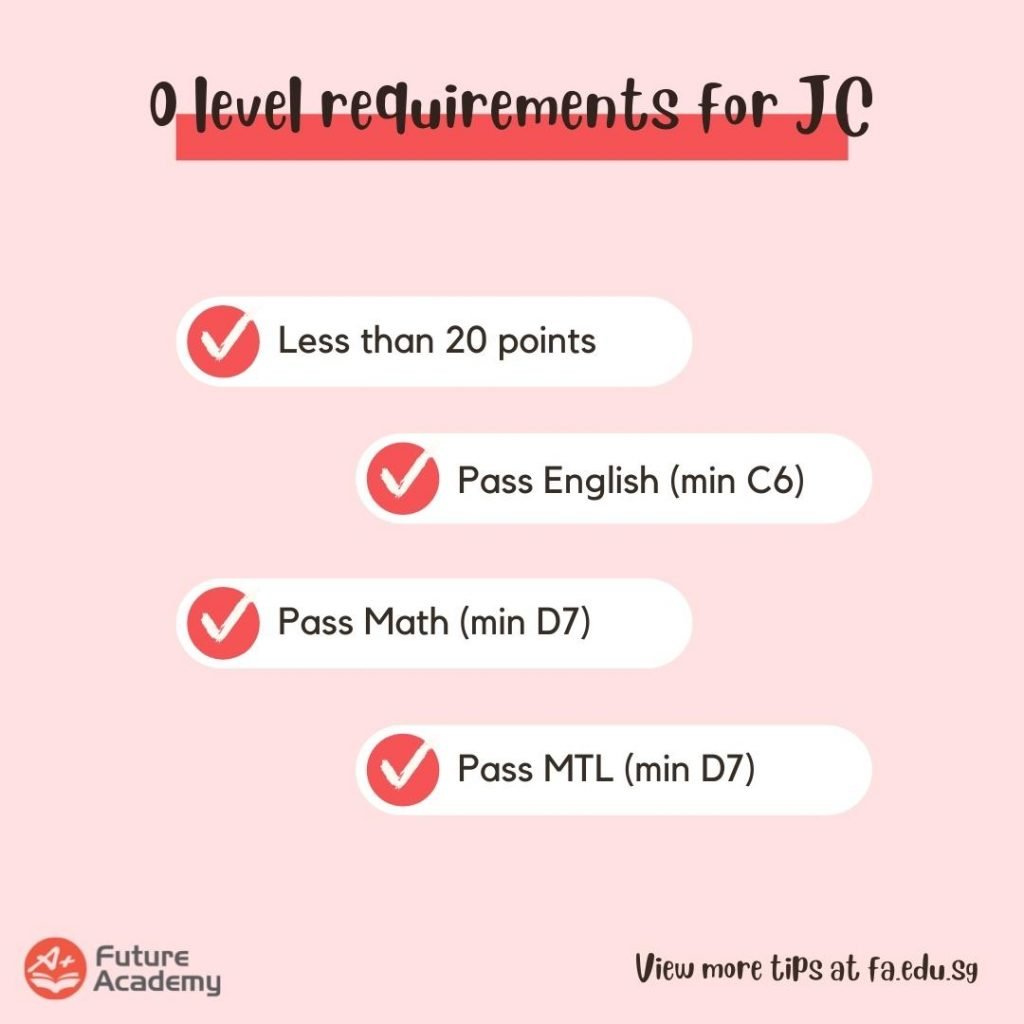
There are really 2 main requirements in terms of O level score for entering JC.
- Your L1R5 aggregate score must be 20 or below.
- You must pass English (minimum C6), at least one math subject (minimum D7) and your mother tongue (minimum D7).
Of course, each JC will have their own cut-off points and competitiveness. Here’s a look at our latest JC cut-off points in Singapore. Take note that these cut-off points do not vary very much from year to year (usually only a 1-point difference, if at all).

For those aiming to get into poly
We’ve mentioned a lot about the JC requirements for O level holders, but what about those who are targeting a place in a polytechnic?
The minimum requirement for entry into poly is ELR2B2 net aggregate score of 26 or less.
ELR2B2 sounds like a mouthful, but it is similar in effect to what L1R5 stands for.
EL = English language
R2 = 2 Relevant subjects
B2 = 2 other Best scoring subjects
Exceptions:
- For Diploma in Nursing, your ELR2B2 cannot be more than 28
Of course, specific course requirements are also in place, so do check out the guidelines for the course you are interested in applying for to see if you meet the criteria!
Conclusion
Once you have a clear picture of the O level scoring system, you can make a better informed decision about the JC you should be applying to! Even for students who have yet to take the O levels, it should give you a better idea of what to aim for.
No matter which side of the O level exams you currently stand, we remain ready to lend you a hand in your studies. We provide O level tuition such as O level physics tuition, chemistry tuition, and more.
In the event you successfully enter your dream JC, we hope we can also walk alongside you to help you prepare for the A levels! Contact us for more information on our A level math tuition, biology tuition, and more!
Read more like this…

The Right JC: Compare Top JCs and Open House Dates (2026)
Mark your calendars for these JC Open House dates and compare the top JCs in Singapore to find the best fit for your next phase of studies.

2025 JC Cut-Off Points: O Level L1R5 For Singapore JCs
Find out the past O Level cut-off points of Singapore Junior Colleges to make an informed choice for JAE!

All About the New L1R4 Scoring For JC Admissions (From 2028)
Understand how the O Level L1R4 will be calculated for students entering JC in 2028, including subjects counted, bonus points, and the impacts it will have.