
A “C” Is Not Always Bad: How To Look At Your Test Results

What’s the first thing that comes to mind when you see your test results?
For some students, anything less than an ‘A’ feels like a failure. Others feel demoralised when they see a ‘C’ grade or below. Sometimes, it’s not just the students — parents may also feel anxious or concerned when they notice a sudden drop in their child’s grades.
But as IP tutors and JC tutors in Singapore who have guided many students through their academic journey, we want to offer a different perspective: Your test score doesn’t always tell the whole story.
A ‘C’ grade might suggest gaps in understanding — but it could also reflect a tougher paper, a jump in academic standards, or unfamiliar question types. In many cases, students lose marks not because they don’t understand the content, but because of weaker exam techniques, time management, or presentation.
Before jumping to conclusions about your results, here are a few important questions to consider.
What level are you studying at?
The higher the level, the harder it is to achieve top grades.
In primary school, a ‘C’ grade might be worrying. But in JC, a ‘C’ could be the average or even the top score for a paper. Students who were top scorers with straight AL1s in PSLE still struggle in JC to get B’s or C’s.
This is because grading standards, mark ranges, and expectations vary significantly across levels. JC exams are often a lot more difficult and pitched that way to challenge students and prepare them for the A Levels. Understanding this context helps you have more realistic expectations of yourself (or your child) at each level of their learning.

How difficult was the paper?
Not all test papers are created equal.
Some schools are known for setting more challenging papers, and difficulty levels can vary from year to year. This means it’s not always meaningful to compare your results with a friend from another school or with your seniors from a different batch.
Practising with past-year papers can give you a sense of the range of difficulty levels of questions to expect. If you usually have no problem with past year papers, but you did poorly for the current test, then it might be a sign that the paper was just particularly difficult.
How did others perform?
If you’re still unsure how well you did, look at the bigger picture.
Try to find out how your peers performed overall. Did your classmates score lower than expected? Or did most perform well? This helps you estimate where you stand relative to the cohort.
The goal isn’t to compare and judge your friends, but to just understand where you stand. Perhaps everyone is struggling with the same topics and did poorly as well – or this was an especially ‘killer paper’. In some cases, schools might moderate the marks – a tell-tale sign that the paper was too difficult!

Where did you lose marks?
This is perhaps the most important question.
Review your paper carefully and identify the types of mistakes you made. Were they:
- Conceptual errors (lack of understanding)?
- Careless mistakes?
- Missing keywords or incomplete explanations?
- Poor time management?
Sometimes, test pressure causes students to underperform, even when they understand the content. A lower score doesn’t mean that you are not capable – there might just be some techniques that you need to work on to improve your performance.
Stay on top of your studies with Future Academy
If you’re currently attending a JC or secondary school tuition class at Future Academy, rest assured that you won’t have to figure this out alone.
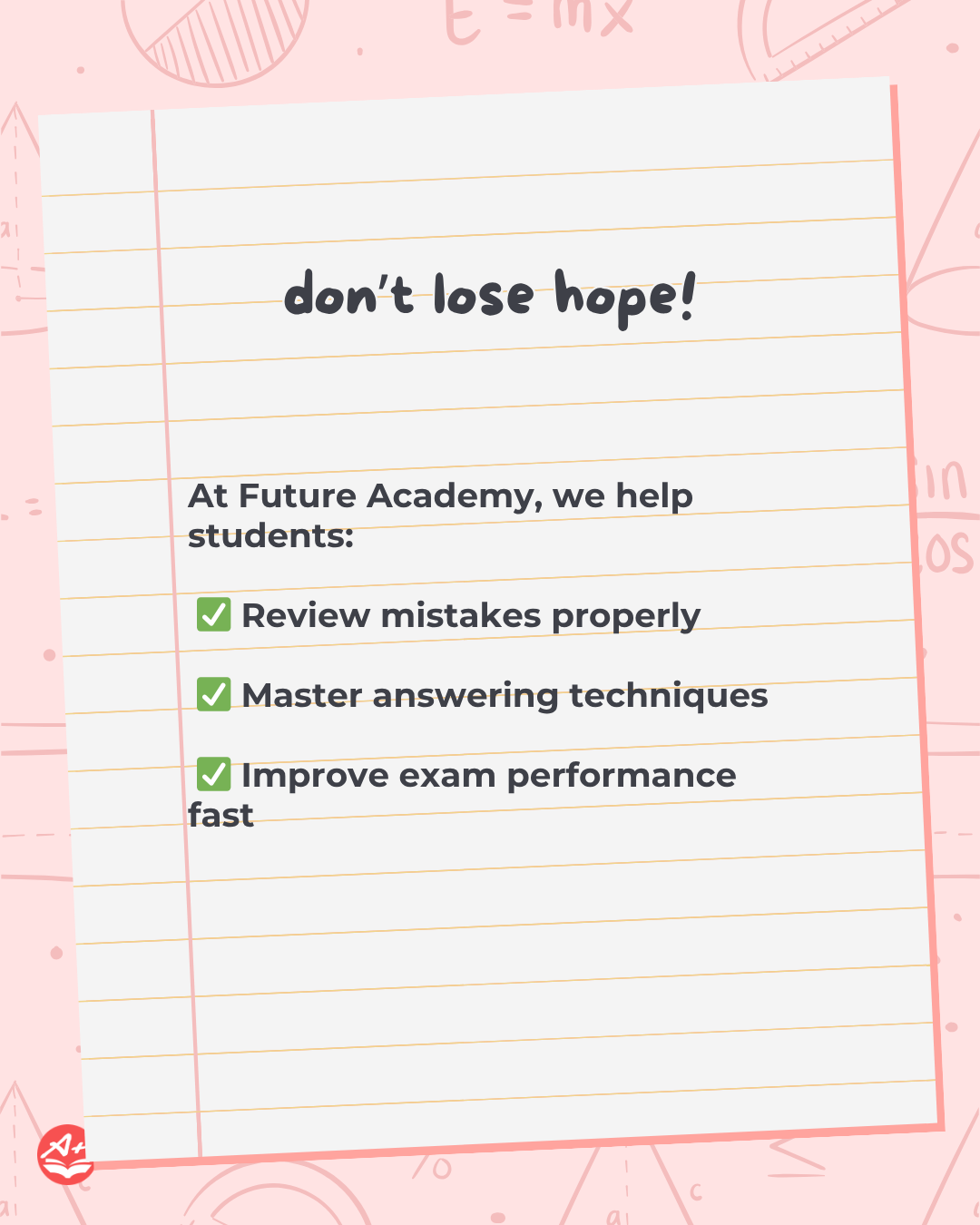
Our tutors regularly review students’ test papers with them, helping to pinpoint areas for improvement and providing clear, actionable strategies to do better next time. We don’t see tests as the final judgement, but as valuable feedback for growth.
Beyond school exams, consistent interaction with your tutor also gives you a clearer picture of your progress. Through weekly lessons, guided practice, and timed exercises, students receive ongoing feedback that helps them improve steadily and confidently.
Conclusion
Putting your test results into perspective is not about making excuses – it’s about understanding the full picture.
By analysing your performance carefully and focusing on improvement, you can turn setbacks into meaningful progress. With the right guidance and strategies, even a disappointing result can become a stepping stone towards better outcomes.
If you’re unsure how to move forward or concerned about your grades, don’t hesitate to seek support. Speak to your tutor, or get in touch with us at Future Academy to find out how we can help you improve with clarity and confidence!
Read more like this…

Our A Level 2025 Highlights: Results & Improvements
Join us in reviewing the highlights of our students’ 2025 A Level results, a testament to their hard work and dedication!

O Level 2025 Results: How Did Our Tuition Students Do?
Discover our highlight reel of our students’ best results and improvements from the 2025 O Levels!

3 things Top Students Do In January That Help Them Excel
Start the new school year afresh with these study habits for better productivity and performance!